
Historical Overview of Lebanon Baptist Church: 190 Years of Faith and God’s Faithfulness
Humble Beginnings
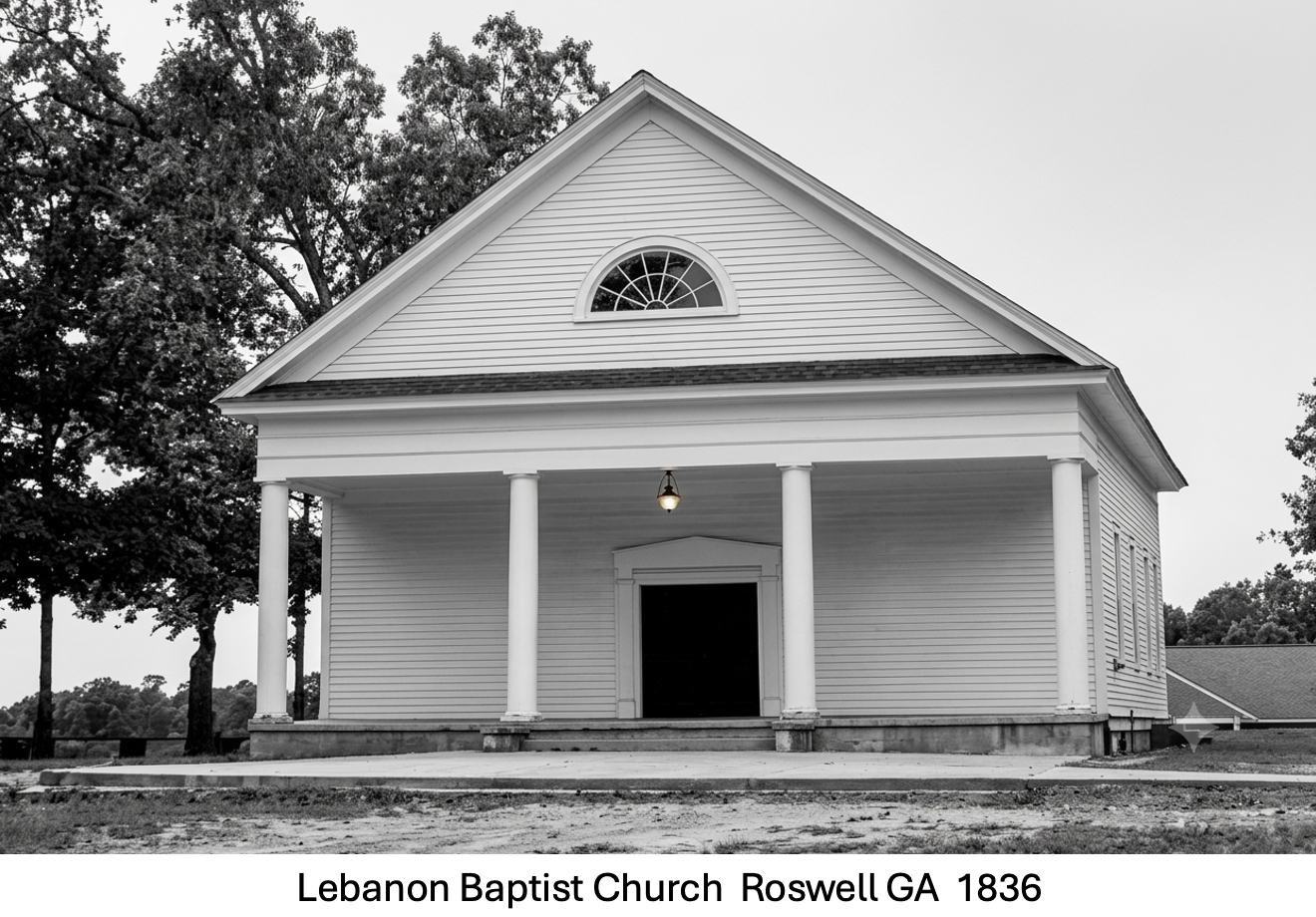
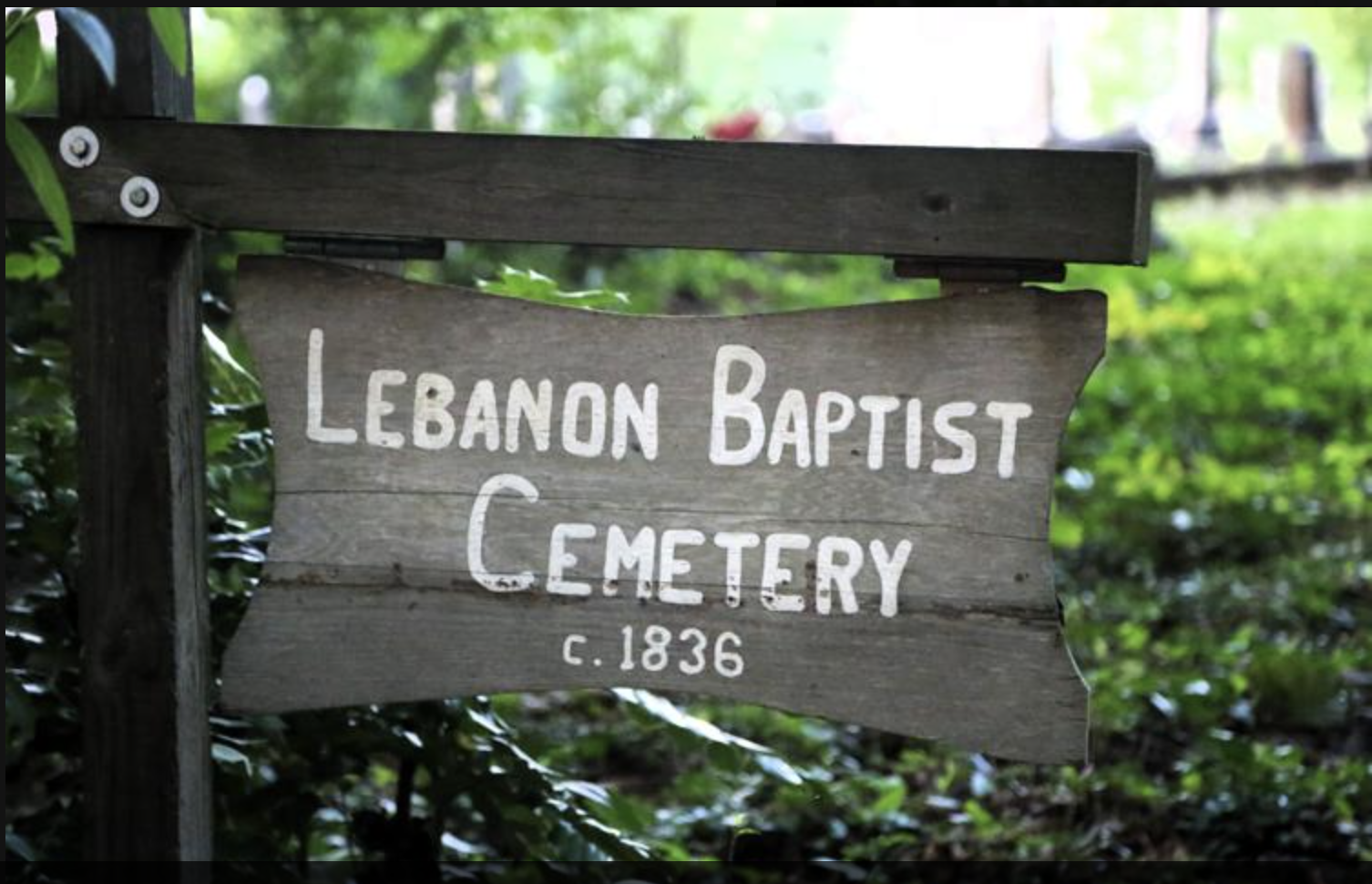
The legacy of Lebanon Baptist Church of Roswell, Georgia began with a small group of faithful people who determined to follow Christ and make Him known throughout their community and the world. Long before Roswell was a sprawling, affluent suburb replete with comfortable neighborhoods and upscale shopping and restaurants, the area was a sparsely inhabited farm community known to locals as Lebanon, GA. The small farm community lay just outside of the town limits of Roswell, and was eventually absorbed into what today are the cities of Roswell and Canton. Lebanon experienced a surge of growth in the early 1830’s when pioneering settlers were attracted to the area by the Gold Lottery, which offered farmland to qualifying families. Among those who secured property were Amariah Hembree and his family. In fact, it was in the Hembree home, located in what was then Lebanon, GA, where a small group of families first met to worship together. Within a few years, the gathering recognized the need for a formal “meeting house,” and James Hembree built that first church, what was probably a log-cabin style structure, at the cost of $158.50. That first Lebanon Baptist Church stood near the present site of Northside Baptist Church on Houze Road, and the church’s cemetery remains to this day, still maintained by Lebanon Baptist Church.
Antebellum Roots
In its early days as a church in the antebellum deep South, services at Lebanon Baptist would have looked a bit different from those of today, as their procedures and practices reflected the customs and norms of their time period. Up until the 1930’s, men and women sat on opposite sides of the sanctuary. Several benches located to the left of the pulpit were designated “Amen Corner” and reserved for deacons and older men. The “singers” (choir) were located in front of the pulpit in the early days and then later moved to the right of it, opposite “Amen Corner.” Up until the 1960’s, there was no nursery, so babies played on quilts laid out on the floor, and from an early age, children were taught to sit quietly during the services. Foot-washing was a regular aspect of the services in the 1800’s, as was annual communion. Most of the preachers in those days served multiple congregations on monthly rotation, so many ministers served the Lebanon congregation for only a short time.
From its inception, Lebanon Baptist Church sought to adhere to biblical principles in both biblical matters and social issues. Unlike many churches in the antebellum South, slaves were welcomed as members at Lebanon and worshipped with the white members. Burt Hembree, an African slave, was ordained to preach, and his brother, Alec, was ordained as a deacon. In fact, they were among the first black men to be ordained in the United States. The church also contributed to the well-being of the surrounding community in many ways. For instance, in the 1840’s when a drought and locusts devastated Georgia’s rural economy, the church organized the Lebanon Cobb County Agricultural Society to financially and practically help destitute families. The society provided food, clothing, and even interceded with creditors on behalf of indebted farm families. Lebanon Baptist has always been a community church.
In 1860, the growing congregation built a new church atop a small hill at what is today the intersection of Alpharetta Highway and Holcomb Bridge Road. This was a tumultuous time, however, and during the Civil War, the Union Army, under the command of General Sherman, briefly occupied Roswell. For most of the summer of 1864, 36,000 troops occupied the town, and the Union army appropriated wood from the new church building to construct rafts and/or a bridge to cross the river after the Confederate Army burned the covered Chattahoochee Bridge to delay the advance of Union soldiers.
Reconstruction and Beyond
Shortly after the war, the resilient congregation of Lebanon Baptist Church rebuilt the structure, which remained in use until 1916. That year, during a revival meeting, so many people crowded into the building that the floor caved in, resulting in a vote of approval by the congregation to build a new church. That effort was lead by then pastor Rev. C.H. Jennings. In 1938, Sunday school rooms were added to the 1916 building (prior to that addition, everyone met in small groups in the sanctuary). In the 1950’s, two more rooms were added, and in 1960, the exterior was bricked.
1969 was a pivotal year in the life of Lebanon Baptist Church, for that is the year Rev. Dick Hester was called by the congregation to serve as senior pastor, a role he faithfully filled for 34 years. As the population of Roswell boomed during those decades, the spiritual leadership of Dr. Hester greatly contributed to the church’s tremendous growth, with membership rising to over 700, and the church staff expanding to 4 pastors plus additional support staff. In 1974, a new sanctuary was erected next to old building (which continued to be used), along with an educational building and a youth/recreation building. God continued to grow Lebanon Baptist Church over the next two decades, and in the mid 1990’s, a larger facility was needed. The members voted to purchase nearly 30 acres of land at the intersection of Crabapple and Chaffin Roads, ironically just a few miles from the site of the very first Lebanon Baptist Church building. The new church was completed in 1996 and celebrated its first service on Easter Sunday of that year. Four years later, a new wing with additional classrooms and a gym was added to the structure—a testimony to the stewardship of the church’s leaders and the generosity of the church’s members.
Enduring Legacy
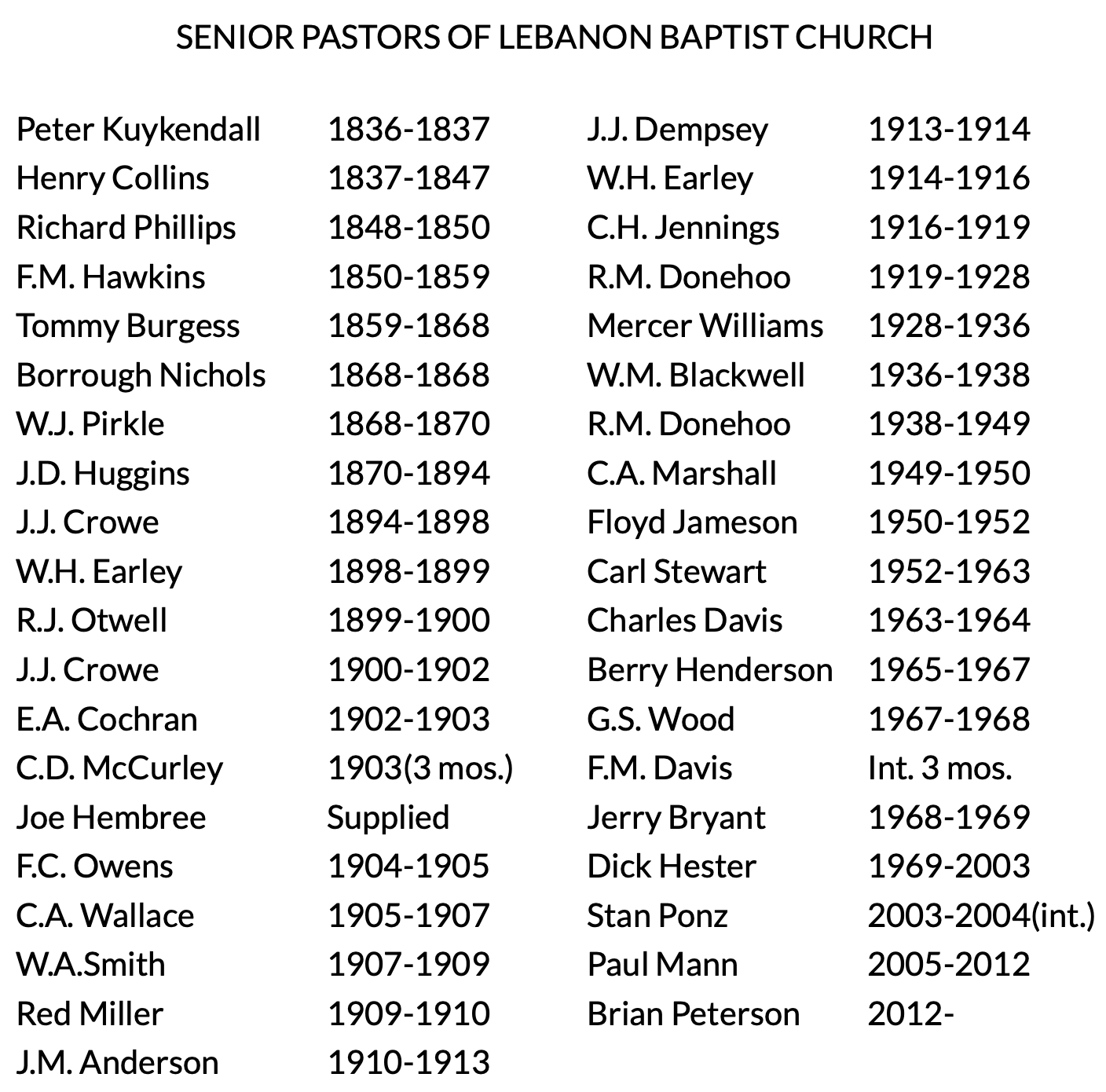
Over its 190 year history, Lebanon Baptist Church’s singular purpose has remained the same: to make disciples of Jesus Christ for the glory of God. It has sought to do this in its surrounding community, the greater Atlanta area, and throughout the United States and the world. Missions has always been an integral aspect of the church’s focus, as evidenced by its generosity in sending and supporting missionaries as well as supporting numerous mission organizations. Lebanon Baptist has experienced times of struggle and decline and times of plenty and growth, but at all times, God’s faithfulness has been evident. The congregants have gathered in 5 different buildings, been lead and taught by 39 different senior pastors, and the church has changed its affiliation 3 times (from Missionary Baptist to Southern Baptist to Independent Baptist), yet the resolve of its founders has endured in the church’s aspiration to “live in the spirit of meekness and brotherly love, striving to keep the unity of the Spirit in the bonds of peace” so that nothing may hinder “the cause of Christ.”